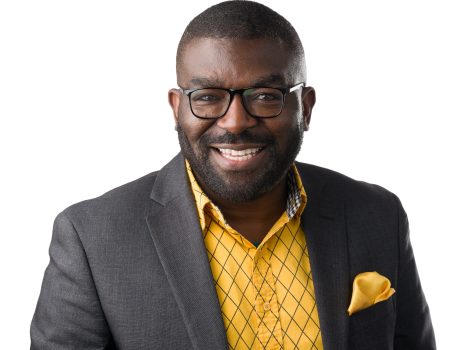
Dr. Otieno, the teacher
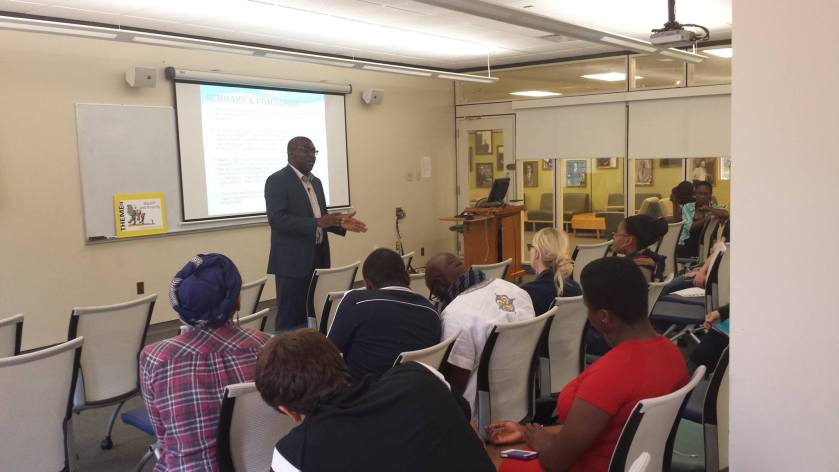
Teaching has always been my passion. As evident from my academic journey, I have been associated with the teaching role since 1999 when I taught at St. John Informal School in Korogocho, and thereafter provided in-service training programs that targeted teachers from the informal schools in the slums of Nairobi under the auspices of Busara project. I have facilitated both community-based and high-level professional-focused workshops/seminars that targeted policymakers, government officials, and representatives of non-profit organizations. Over these years, I have learned and continually reinvented myself to become a better facilitator and educator. Viewing teaching as an ongoing journey that advances with time and experience, I have embraced diverse teaching methodologies, experiences from various kinds of individuals including students, and invested the time and effort to benefit from diverse areas of interest. As a first-generation native of a developing country, I am a lived example of how education changes lives. I have also seen how quality education can change individuals, societies, and countries at large.
My teaching Philosophy
I consider teaching as an institution of mentorship and guidance. My goal as a teacher has been very focused on the need to facilitate the acquisition of transformative knowledge and to impart quality education that leads to positive differences in the lives of others.
As teachers, we are given the enormous task of guiding the transformation of lives through exposure to novel concepts and content. My role as an educator derives its greatest strength from the realization that I can make a positive difference in the lives of others. I can contribute by helping create a nurturing environment for students, which leads to innovation and critical thinking. My approach to teaching reflects my experiences with my own teachers and mentors, as well as my belief that learning spaces help explore emerging ideas. Over the years, I have benefitted from great teachers, and my objective is to offer similar professional development to my students.
As a scholar, I view teaching as an art in which we construct an inclusive and protective environment where effective learning can take place. As a co-learner in the learning process, I contribute to the learning dynamic based on the curriculum and experiences while the students as critical thinkers also contribute based on their acquired knowledge, questions, experiences, and general feedback. I learn from the students as they also learn from me. I, therefore, work hard to create a conducive collaborative learning environment that fosters critical thinking and problem-solving. To realize this, I present information in the most compelling way possible – often through interactive teaching aids and experiential learning opportunities. I also bring in real-world examples in the form of case studies and professionals from the field of study. I enjoy sharing my experiences and insights with students and have taught courses both online and face-to-face, and sometimes I have held both virtual and face-to-face classes simultaneously as part of accommodating students who for various reasons have not been able to attend face-to-face classes.
My teaching philosophy is best described as commitments to four pillars: flexibility, affective learning, knowledge sharing, and student-centered learning. Being flexible as a teacher means I try to be adaptable, affirming, and open. I strive to continuously develop class content that is engaging and thought-provoking with relevant case studies. I encourage collaborative knowledge sharing of all students’ lived realities through guided discussions, exemplars, and anecdotes that extend beyond the boundaries of the classroom. I also believe that teaching is a student-centered venture as I view students as equal partners in the learning process. Lastly, my affectiveness as a teacher means I embrace the concept of walking through the learning process with my students. I employ an affective teaching strategy that fosters a safe environment through relational techniques such as immediacy, diversity, and inclusion.
Diversity and Inclusion. I greatly value diversity. In this case, diversity is not limited to racial diversity, but diversity in reasoning, thought and scholarship that emanates from belonging to different backgrounds and life experiences. Diverse opinions and perspectives afford me an opportunity to inspire and empower students through the careful reflection of complex and conflicting issues.
My passion is to facilitate knowledge that enables my students to prepare for the real world and to take their place as responsible and effective members of the global community.
Courses taught at Ohio University
- Global Health Research and Services
- MDIA 4176 Technology, Communication, and culture (Fall 2019/2020; Spring 2019/20; Fall 2020/2021) – Both F2F & Online
- MDIA 4120 Advanced social media (2019/2020 Spring semester) – F2F & Online teaching
- MDIA 3150 Global Media Systems (2019/20 Fall semester)
Courses taught at Utah State University
Fall 2023 courses:
JCOM 2020 – Communication Research Methods
JCOM 5400 – Social Media Analytics
JCOM 5040 – Social Media, Philanthropy and Advocacy
Spring 2023 courses taught:
JCOM 2400- Introduction to Social Media
JCOM 2020 – Communication Research Methods
JCOM 4020 – Media and Society
JCOM 4040- Social Media Content Development
Fall 2022 courses taught:
- JCOM 5400 – Social Media Analytics and Client Management
This course introduces concepts, computational tools, and best practices in big data analytics and client management. Emphasis is placed on collecting, analyzing, and visualizing social media data. - JCOM 2020: Communication Research Methods (QI). Quantitative Intensive.
This course covers quantitative research methods used in the mass communication field. Practical application of quantitative information within journalism and public relations. Emphasizes using numbers to help audiences make sense of issues and events. - JCOM 3320 – Strategic Research Methods in Public Relations (DSS) DSS Depth Social Sciences
This course covers qualitative research methods standard to real-life applications in public relations problems and campaigns, including focus groups, case analysis, and strategic assessments.
 Dr. Aggrey Willis Otieno